He recollects his childhood mofussil home where, as a young boy he would imagine portraits of men, outlines of veiled women and patterns of strange animals with differing sizes and peculiar shapes. All on the walls of his home where dampness and dullness due to moss and lichen vie to eat out the wall’s natural texture and colour.
In recent times, we talk more about paintings. This is so since I find him drowned in the process more than anything else almost every time, I visit him now.
When at work stooping on his drawing book, I find him almost motionless. Only when I go near, I can find him moving his hand in quick strokes towards a corner of the page. Or maybe the middle, or somewhere on the sides. But, almost motionless, still and muted like the figures on the pages or the statues in museums.
‘Why did you draw portraits or the human figures so many?’
‘I think the human face fascinates me. And as an actor, I do tend to be drawn to expressions on the face. But I have drawn other themes as well, landscapes,’ he does draw a lot of landscapes and abstract ones but more so in recent times.
Crisscrosses and dense lines that intricate the faces. All facing the viewer but any seldom looking at him. Every time I look at portraits of any artist where there is no eye contact, I can smell death. The non-verbal communication between a portrait and its viewer gives the paintings their life. It injects a sense of joy in me as well. The eyes of a painting watch life with glee and makes me look at my life and beyond with equal restrained passion. Else life will be grim, dreary and fearful.
The scribbles started off as practices between busy schedules, a form of idling without being lazy. There is no formal training, neither a casual one apart from being friends with painters of repute.
So why does a man draw portraits? Whom does he draw even? Throughout my student life I did fill in the back pages of exercise copies with replicas of some bearded men. Not all same but similar. I don’t know whose face it was. And I normally used to scribble profiles of side faces instead of frontal ones. Soumitra-babu’s drawings face me but seldom look at me. I don’t really understand what we look at when we look at portraits. Do we wish to imagine the painter’s life? Or we look at our lives through the portraits – a bridge, a communion to another life?
‘Who are these women? You must have known them as well, like the men you said,’ I ask him as he is flipping through his drawing book.
‘Yes, but not any one woman as such, different,’ his fingers paused at one.
‘Less women and less portraits. You painted women in full or waist up,’ I wish to probe further.
‘I don’t know if there is any reason for this. I drew whatever came to my mind. I don’t have a plan beforehand, most of the times, when it comes to paintings.’ He says in a matter-of-fact way.
The question of looking at the paintings and by the figures captive in the canvas resurfaces in my mind. Somehow, I feel the vulnerability of the artist is exposed before the female figures. Is the male viewer threatened in the same way? Is he worried as well to confront the challenge?
And, there are no children in his drawings. I wonder now why children are left out of our literature, painting, cinema and music. At least most of it. I suddenly feel sorry for the children of the world. Why is it that we love children, play with them, cuddle them and yet afraid of including them in our art?’
Do we find ourselves too serious most of the times? Children spread a form of diffused love that unifies all characters that it falls upon. As adults we constantly look for trenches and troughs. Children destroy the differences and distinguishes darkness from light. They thrive their growth on fear. For us, art is in obliterating that fear.
‘Amitava, don’t we have fears as well? The ones that make life difficult?’ he asks me with a pensive smile.
At his age now the boundaries between truth and falsity are getting blurred. And I can see how hisface holds the morning sun in gorgeous rhapsody. If becoming old means a want to remain young but giving up seduction, he looks green like the tiny leaves in waiting.
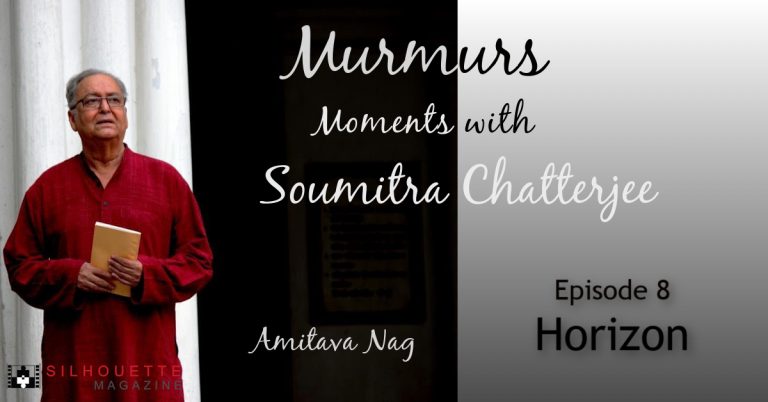
This is a preview collection of interactions that is set to release as the book Murmurs: Moments with Soumitra Chatterjee by Amitava Nag, on 19th January 2021 to celebrate the legend’s 87th birthday.

Click here to read all published episodes of Murmurs: Moments with Soumitra Chatterjee.
Catherine Berge’s Gaach (The Tree, 1998) is a rare documentary on Soumitra Chatterjee. Silhouette is grateful to Catherine and producer James Ivory for providing permission to make it available to the Silhouette readers.
More to read on Soumitra Chatterjee
Ke Jaino Go Dekechhe Aamay: The Songs of Soumitra
Soumitra Chatterjee – A Habit of Our Lives
Soumitra Chatterjee on Acting in Satyajit Ray’s Films – Exclusive Interview (Part 1)
Soumitra Chatterjee on Acting in Satyajit Ray’s Films – Exclusive Interview (Part 2)
Recommended Books