

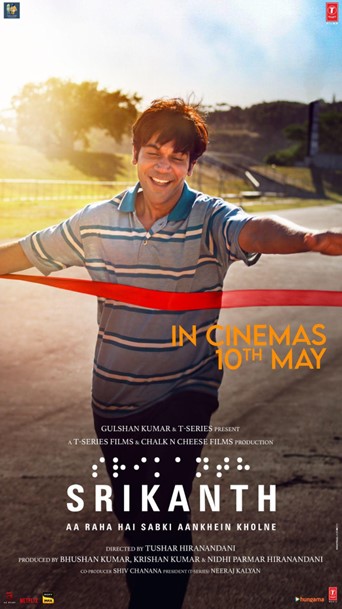
Srikanth is the inspiring biopic of the visually impaired Srikanth Bolla who rose from a humble Andhra village to become self-made billionaire. Director Tushar Hiranandani weaves an awe-inspiring real life story of success against all odds — capturing the life Srikanth who graduated from MIT (Massachusetts Institute of Technology) and became the founder of Bollant Industries.
Rajkummar Rao delivers a finely nuanced performance in the title role of Srikanth Bolla. He captures the character’s internal struggles and triumphs and events and incidents with sensitivity, making Srikanth’s journey feel utterly believable.
Jyothika as Divya, Srikanth’s mentor and teacher, comes up with a fine performance, evolving from initial skepticism to unwavering conviction, particularly evident during the courtroom scenes where she sways not only the judge and principal but also the audience with her persuasive arguments.
Though Alaya F (Srikanth’s love interest) makes the most of her limited screen time as Swathi, the character’s underdeveloped arc stops her from leaving a lasting impression on the audience.
Sharad Kelkar plays Ravi Mantha, Srikanth’s multifaceted confidante. He packs in the roles of entrepreneur, friend, mentor, and investor in one — creating a character that is both reliable and intriguing.
Through Srikanth’s unwavering determination and resilience, the film delivers a powerful message of hope, reminding viewers that the human spirit knows no bounds. It serves as a testament to the fact that with courage and perseverance, one can overcome even the most daunting obstacles and achieve greatness.
From being educated to getting admission to MIT, the first half of the film focuses on the struggles and challenges Srikanth faces, whereas the second half mainly focuses on his success, where he opens his own company named Bollant Industries. Srikanth uses the Qayamat Se Qayamat Tak song Papa kehte hai bada naam karega, beta hamara aisa kaam karega as a musical refrain.

While Srikanth boasts stellar performances and efficient storytelling within its compact runtime, it falters in certain aspects. The film suffers from a limited exploration of some of its characters, failing to delve deeply enough into their complexities. The scriptwriting by Jagdeep Sidhu and Sumit Purohit lacks novelty, adhering to functional storytelling without offering fresh perspectives or engaging narrative twists. Furthermore, despite moments of emotional resonance, the film overall lacks truly impactful scenes that evoke strong emotional responses from the audience, missing opportunities to create moments that would linger in viewers’ minds long after the credits roll.
Overall, Srikanth is a worthwhile watch, especially for fans of Rao’s stellar acting. It’s a feel-good film with a strong central performance, but one that could have benefited from a tighter script and a more incisive exploration of its themes.
More Must Read in Silhouette
Gadar 2: Carrying Forward the Gadar Legacy
Visual Opulence Punched with Masala Destress — That’s ‘Rocky Aur Rani Kii Prem Kahaani’
Sound the Trumpets: The Elephant Whisperers
Satya (1998) — A Game Changer in Gangster Movies



One Response
Hi Rahul
Excellent review of Srikanth!!!
Your detailed analysis, particularly of Sharad Kelkar’s multifaceted character and the film’s powerful message of overcoming obstacles, offers valuable insights.
Thank you for your thoughtful review…