
Long after reading them, some poems linger. Like the scent of a lover. What has always stayed with me, at the forefront or in my periphery, is a ghazal. Integral to my senses. Occasionally, I sing a ghazal in Urdu, to myself, to a friend, to a mate or a memory, and an ache rises within me. Sing it for a love, to a god or a spirit. It is a perfect poem.
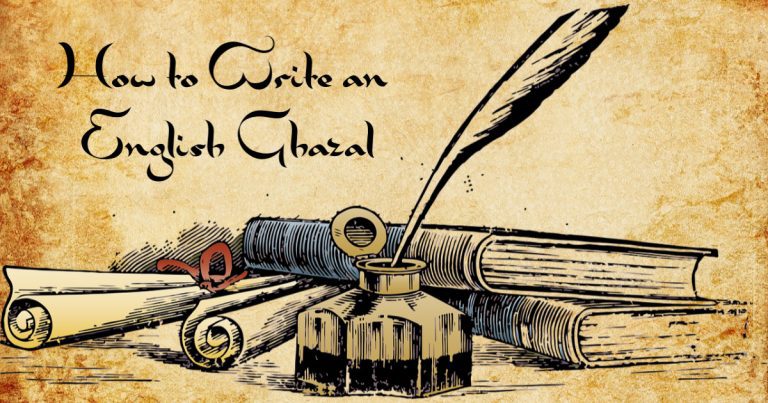
I have heard and sung ghazals in Urdu for years. Then I heard some poets, who write in English, describe a ghazal as a series of free-verse couplets of disjointed thoughts. This is a simplistic distortion of a sophisticated art form.
I recognize everything in life is fluid. Language changes, art transforms itself. But you would not write a 30-line poem and call it Haiku, or a free-verse 40-line poem a sonnet. Free-verse poems strung into couplets are a form of poetry, often beautiful, evocative, arresting. But, to distinguish it from other styles of poetry, a ghazal must encompass and adhere to some basic tenets.

Agha Shahid Ali, who may have been one of the first poets to write ghazals in English in Indo-Persian style, said that, “Each couplet must be like a precious stone that can shine even when plucked from the necklace, though it certainly has greater luster in its setting”.
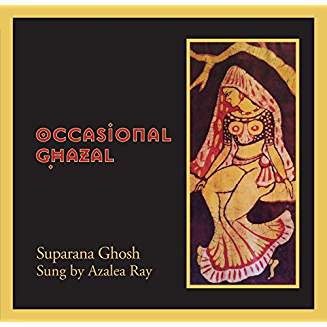
Some of the verses in my latest collection of verses, Occasionally, are written in the form of ghazals in a classical Indo-Persian style, and evoke memories from decades ago, when some lovers of the Urdu language at the All India Radio, New Delhi, opened a dimension which was new to me. As a Bengali girl schooled in English and Hindi, I was unaware of the intricacies of Urdu, of the nuances, of the guttural sounds, of the textures. In these ghazals, written in English, I have aspired to capture some of the romance infused in an Urdu ghazal. To those lovers of the language, I owe much gratitude for imparting some of their love to me.
Although ghazals do not typically have a title, but titles remain an option. Today, my ghazal, Intrusion, will be my muse, to elucidate, demonstrate, above all, capture the spell this form of poetry casts over me.
A series of couplets of disparate or interwoven thoughts, the meter, the repetition, the internal rhyme common to the couplets, together create the magic of a ghazal. Ghazal, meaning ode to women, remains rooted in love, separation, mysticism, but has also come to reflect life in all forms and spheres of human emotions and interactions. In Urdu, it is evocative, often emotionally masochistic, but always lyrical and charming, and never appears maudlin. I believe it’s because of the grace and lyricism of the Urdu language. I hope I have captured some of it in the ghazals I have attempted in English.
Art has always been interactive, encompassing words, paintings, dance, drama and music. But the future is already here. I have attempted to weave this magical time with the seventh or eighth century form of poetry, integrating my paintings and images and my love of performing into short, audio-visual experiences, culminating in the ghazal, Intrusion, emerging as a song.
Here is a heart-warming response to the videos above from John Robert Colombo, author, anthologist and Order of Canada recipient:
“The explorations have led to new kingdoms of the imagination!
They are very professionally mounted and extremely artistic. I felt about the vision common to them the way I felt about Jean Cocteau’s feature films: worlds of their own, rich in strange and forgotten beauties.
“Essence” is sensual without being sexy, and while the sense of the words is lost to English ears, the sensations of the visuals make up for that.
“Intrusion” features a beauteous queen as mysterious and lovely as Nefertiti and the mise-en-scene is extremely engaging. Much movement.
“Intrusion Song” is easier to follow for the viewer for it has the text on screen and the words are sung with great musicality. It is a form of fun to “read along.”
Great lyrical accomplishments and excellence.”
I hope the other readers will react positively as well.
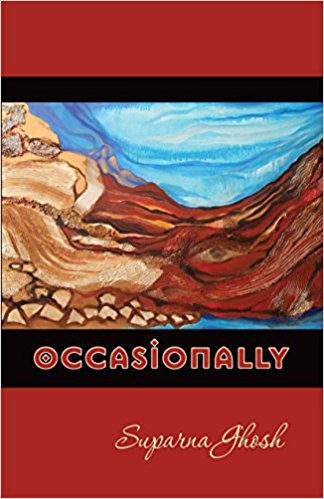
I end with another ghazal from my collection, Occasionally:
Thought
Malleable like a whisper or a wisp of your thought
You careened me into the cusp of your thought
I called you my own your cradle my abode
But now I reside in the lapse of your thought
You are most elusive but you are almost real
A primal text writ on the lips of your thought
I peeled every layer of your being and your breath
But despaired to remove the husk of your thought
In sadness in madness in soaring in falling
I dispelled your presence and the musk of your thought
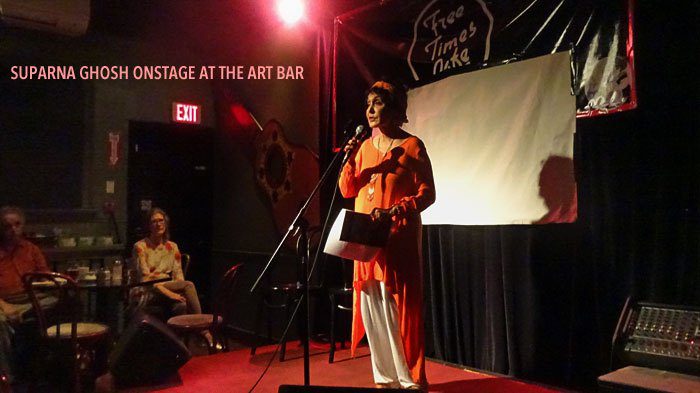
I was one of the founding members of the Art Bar, the longest running poetry-only weekly reading series in Canada. So, presenting the above videos at the Art Bar was a pleasure, even though it was a make-shift affair, typical of bohemian poetry gatherings.
Following the reading was my surprise appearance in this engaging blog ‘Our Suparna Ghosh Week‘ by Bill Andersen, who writes about visual arts, tech topics, and discoveries on daily walks in Toronto, Canada. (Pic courtesy: Billanderson.ca)
More to read